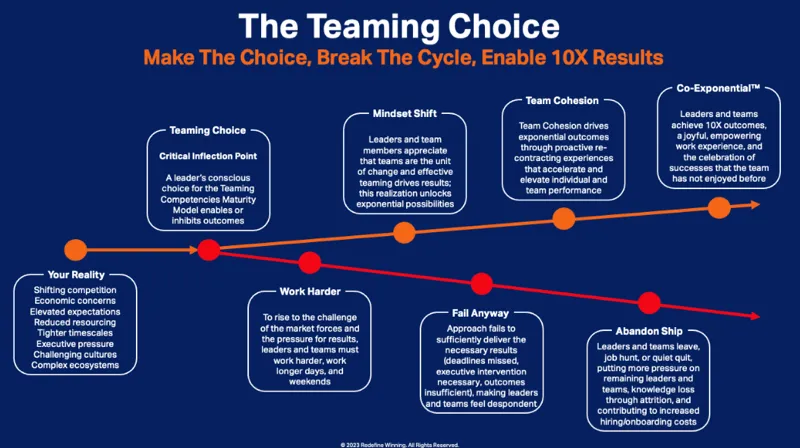
Most leaders we speak with describe the same conditions: shifting competition, economic pressure, raised expectations, lighter resourcing, tighter timescales, and cultures that are harder to navigate than they used to be. At the personal level, it has rarely been harder to feel like you are winning, even for people who love their work.
The Reality That Drains Leaders Today
Long hours, late nights, weekends spent catching up, less time with family and friends. The combination grinds down quality of life and capacity in equal measure. Most leaders react by putting their head down, getting the next task done, and pushing onto the one after that. It looks effective. It feeds the dopamine hit of progress.
What it misses is one of the most important levers any leader has: the team. In the rush to finish, we overlook the people who could help us achieve more, faster, with better results, and with more joy along the way.
The Critical Inflection Point Is a Choice
Every leader, in every cycle of pressure, hits a moment where the response can go one of two ways. We call it the Critical Inflection Point. It is the point at which a leader can either work harder in isolation or step back and engage the team. The choice is rarely loud. It is usually a quiet, almost invisible decision made under pressure.
“Leader” here is deliberately broad. It is not just the manager. It is anyone in the team willing to say one of these things:
- I would like us to win better together.
- I need support to drive the greatest value for our team.
- I think I can do this on my own, but we will get a better outcome if we partner on it.
The teams around us, our peers, the broader organization, and even external partners can help solve problems that look impossible solo. The same interactions that produce exponential results also trigger oxytocin, dopamine, serotonin, and endorphins, which is why effective teaming feels better as well as performing better.
The Old Way Looks Like Resilience and Ends in Attrition
At the inflection point, most teams default to working harder. Longer days. Weekend buffers. Heroics. Over time, the heroics fail to keep pace with the pressure. Deadlines slip, executives intervene, outcomes fall short, and people start to feel despondent.
What follows is predictable. A conscious or unconscious decision to abandon ship. People leave, job hunt, or quiet quit. The remaining team carries more pressure, knowledge walks out the door, and hiring and onboarding costs balloon. The cycle repeats with a thinner roster each time.
The Alternative Unlocks Co-Exponential Results
When a leader or an enlightened team member raises the option to own success as a team, the mindset shift opens up something different. People appreciate that the team is the unit of change and that effective teaming is what drives outcomes. From that point, the possibilities compound.
Our methodology, refined over twenty years and called Team Cohesion, is the set of mindsets, behaviors, and tools that produce these results through proactive re-contracting experiences. Teams that lean into it routinely deliver 10X outcomes, with a more empowering work experience and successes worth celebrating that the team had not enjoyed before.
Stop to Go Faster
We have run countless sessions where the most useful thing we can do is ask people to stop. Recently, we worked with a division so focused on rapid impact at scale that colleagues were competing with each other in the marketplace, wasting resources and confusing customers. Through targeted business topics paired with activities that exposed the inefficiencies, we created an inflection point where the team could see what they were leaving on the table.
Three practical moves help you do this for yourself, even without external support:
- Engineer psychological safety so people will be honest about what is actually happening in the team.
- Hold an honest conversation about how the team is performing, knowing that you may have to hear things about yourself while facilitating it.
- Make sure all voices are heard. In typical team meetings, only 25 to 35 percent of voices ever surface. A team inflection point requires everyone in the room.
Each step is harder than it sounds, which is why most teams never get to the conversation.
What This Means for Leaders
Re-contracting how a team operates is the most worthwhile conversation many leaders ever have. What if you accelerated and elevated outcomes? What if you got your evenings and weekends back? What if you 10X’d your impact?
The Critical Inflection Point is not a moment of crisis. It is a moment of choice that arrives quietly under pressure. The leaders who recognize it and act on it stop trying to win alone and start winning with the team they already have.