People contribute value to a team in different ways, and most of those ways are invisible until something goes wrong. Just as individuals have different love languages for expressing affection, team members have distinct contribution styles at work. Measuring everyone against a single standard, usually charisma or output volume, hides the contributions that actually keep the team functioning. Naming those contribution styles is the fastest way to design a team that performs.
Six Archetypes That Cover How Real Teams Work
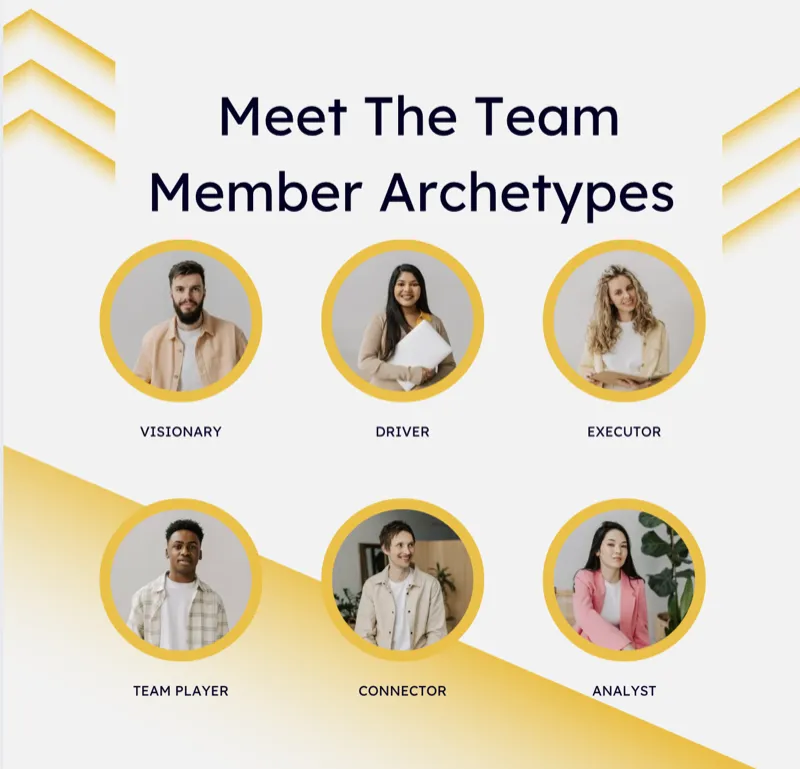
Six archetypes consistently show up across corporate, nonprofit, and startup teams. Each one brings distinct strengths, predictable blind spots, and a different way of moving work forward.
- Visionary (Innovator). Future-oriented idea generator who challenges the status quo, reframes problems, and paints compelling pictures of what could be. Strong at opportunity spotting; weak on follow-through.
- Driver (Go-Getter). Results-driven pacesetter who creates urgency, makes quick calls, and rallies people toward milestones. Strong on decisiveness; can crowd out quieter voices.
- Executor (Producer). Reliable implementer who turns plans into deliverables, builds checklists, and tracks progress. Strong on quality; can be inflexible when conditions change.
- Team Player (Supporter). People-first glue who protects cohesion, mediates conflict, and onboards new members. Strong on psychological safety; tends to avoid conflict and self-silence.
- Connector (Bridge-Builder). Networker who scouts external insights, makes introductions, and aligns stakeholders. Strong on cross-functional flow; can fade on follow-through.
- Analyst (Critical Thinker). Evidence-first evaluator who models options, surfaces risks, and provides calm logic. Strong on rigor; can fall into analysis paralysis or get drowned out in loud rooms.
Most people have a primary archetype and a secondary one that shifts with context. With practice, anyone can stretch into any style.
Why Naming The Mix Matters
Once contribution styles have a shared label, problems that looked like personality clashes turn out to be design flaws. Visionary and Executor pairs convert ideas into outcomes. Driver and Team Player pairs combine pace with cohesion. Connector and Analyst pairs widen inputs while raising the evidence bar. Without that pairing logic, teams default to whoever is loudest and quietly under-use the people whose contributions are less visible.
The practical payoff shows up across the operating rhythm:
- Faster execution when urgency from Drivers, rigor from Analysts, and reliability from Executors are sequenced rather than competing.
- Cleaner handoffs when Connectors are made explicit seam owners across functions.
- Higher retention when “invisible work” by Supporters and Analysts becomes visible and recognized.
- Fairer reviews when contribution type is credited alongside output volume, rather than charisma being mistaken for performance.
Common Archetype Conflicts And How To Resolve Them
Predictable tensions emerge once you map archetypes onto a real team. Driver versus Analyst plays out as a fight over decision speed and evidence; the fix is to agree a decision window and a “good-enough” evidence bar before the meeting. Visionary versus Executor plays out as friction between exploration and execution; the fix is to separate divergent ideation from convergent planning, and to lock scope before work starts. Connector versus Team Player plays out as a debate over widening the circle versus protecting focus; the fix is to define when each is appropriate.
In remote and hybrid contexts, the archetypes need explicit scaffolding: tagged decisions in chat tools, written ideation docs, risk logs, and clear “who’s on point” boards. Without that, the loudest archetype dominates by default.
How To Use Archetypes Without Boxing People In
Archetypes are hypotheses, not verdicts. Use them to design pairings, balance airtime, and clarify decision rights, not to label people for life. A useful rollout looks like this: a thirty-minute introduction with self-identification, a team map of primary and secondary archetypes, a working-agreements refresh covering airtime and handoffs, a pairing matrix for the next sprint, and a metrics review six weeks later.
A facilitated team-building experience can give your team a setting to practice those working agreements.
Track the things that actually move: decision-to-delivery cycle time, rework rate, handoff failures between functions, engagement, and customer response time. Reassess quarterly, or after any major change such as a leader swap, reorganization, or M&A event.
What This Means For Leaders
Most teams that feel “smart but stuck” are not broken; they are mis-paired. They suffer from imbalanced archetype mixes, unclear decision rights, and recognition systems that reward only the most visible contribution styles. Naming the mix and designing rituals around it converts that diagnosis into action.
The leaders who get the most out of their people will be the ones who treat archetype design as part of the operating model, not as a personality exercise. Win conditions get clearer, invisible work becomes visible, and the team starts crossing the finish line together rather than in shifts.