Simon Sinek taught a generation of leaders to start with why. The why gets a team excited about the destination. It does not, on its own, get them there together. The harder question, the one most teams skip, is how. How will we work together to deliver this? Our research shows that the teams who answer that question well outperform those who don’t by an order of magnitude.
The Question Almost No Team Actually Asks
Picture a rowing crew. Without a shared way of working, every rower pulls in a slightly different direction and the boat drifts. With it, the same people propel the boat at speed. The same dynamic plays out in every team in every organization, yet 99.99% of teams have never had an explicit conversation about how they will work together. That single omission explains why only 5% of teams report achieving their full potential.
Teaming competencies are the skills, behaviors, practices, and attributes that let people work as a coherent, high-performing unit rather than a group of capable individuals. They are poorly studied, poorly understood, and poorly applied, which is why most teams stay stuck.
The Teaming Competencies Maturity Model
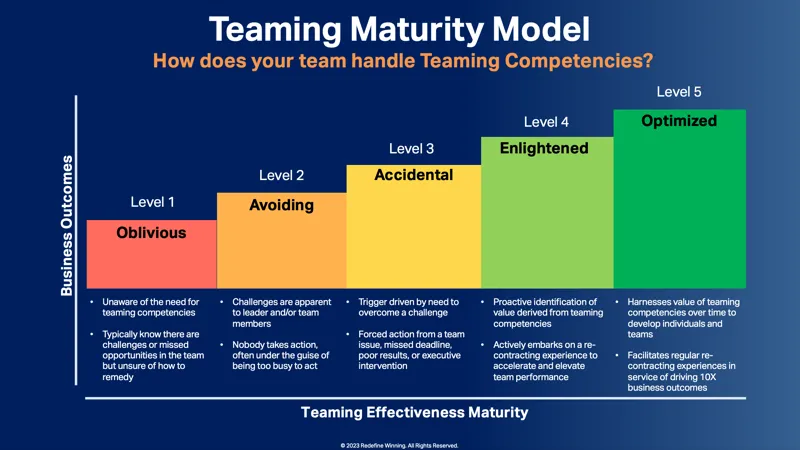
To make this practical, we use a Teaming Competencies Maturity Model. It is a diagnostic framework for assessing how mature a team’s collaboration actually is, not how mature its members assume it to be. The model evaluates communication, collaboration, conflict resolution, decision making, problem solving, leadership, peer-to-peer coaching, trust, and psychological safety.
It maps a team to one of five stages, each one capable of producing materially different business outcomes:
- Oblivious. The team senses something is wrong but cannot diagnose it. Most leaders default here because the functional skills that earned them the promotion never included teaming.
- Avoiding. The issues are visible to everyone, but nobody acts. “We’re too busy” is usually a cover for not knowing what to do.
- Accidental. Teaming gets attention only after a crisis forces an intervention. Relief is real but short-lived because the underlying habits don’t change.
- Enlightened. The team chooses to work on how it operates, brings in expertise, and starts opening possibilities that previously felt out of reach.
- Optimized. Teaming conversations become a regular cadence. The team adjusts as people, priorities, and conditions shift, and 10x outcomes become repeatable rather than lucky.
The higher the stage, the larger the gap between effort spent and outcomes produced. The Optimized stage doesn’t deliver linear improvements; it compounds.
Why Most Teams Land at the Bottom
It is not the team’s fault. Society has invested heavily in technical, functional, and leadership training and almost nothing in teaming. 86% of leaders cite a lack of collaboration as the top reason their teams miss outcomes. Most people don’t know the discipline exists, let alone that it can be learned. They simply notice that work keeps getting harder, days keep getting longer, and the only personal time left is what’s needed to eat and sleep.
There is no shame in starting at Oblivious or Avoiding. The point of the model isn’t judgment; it is direction. Wherever a team begins, it can move, and movement compounds quickly once the conversation starts.
Climbing the Model in Practice
Moving up the model is not a separate workstream layered on top of the day job. The most effective interventions happen inside the team’s actual work. Instead of off-sites, trust falls, or one-off events that fade within weeks, teams use real business challenges as the venue for trying on new mindsets and behaviors.
A few patterns repeat across clients who advance:
- A leader stops carrying the load alone and renegotiates how responsibility is shared.
- The team treats how it works together as a topic worth structured time, not an afterthought.
- New behaviors get committed to and reinforced, not left as posters on a wall.
- The team raises its own targets once it sees what it can deliver together.
Teams at the Optimized stage make small, regular adjustments for new joiners, new leaders, and shifts in the environment. That cadence is what keeps performance from sliding back.
What This Means for Leaders
The maturity model is a mirror, not a verdict. It shows where a team actually operates today and what is possible from the next stage onward. The leaders pulling away from their peers are not working harder; they have stopped leaving teaming to chance and started treating how the team works together as the highest-leverage investment available to them.
The honest question for any leader is whether the team has ever sat down and agreed how it operates. If not, that conversation is the shortcut to better outcomes, fewer hours, and a more sustainable career trajectory for everyone in the room.