In 1968, Garrett Hardin used the tragedy of the commons to explain how shared resources collapse when individuals act only in their own interest. The same dynamic plays out inside teams every day, and it is one of the most overlooked drags on performance. When team members optimize for themselves, even reasonable goals slip out of reach, and the exponential outcomes most organizations now expect become impossible.
Me, You, or Us?
Hardin’s warning that “ruin is the destination toward which all men rush, each pursuing his own best interest” maps cleanly onto modern teams. A team is a small commons that depends on collaboration, communication, and shared goals. When individual ambition is left unchecked, the group’s success quietly erodes.
The contrast is easy to see in the wild. Enron collapsed because individual gain was elevated above collective integrity. Dysfunctional political committees stall because members defend personal or party interests over the common good. SpaceX’s Falcon 9 program runs the other way: each contributor brings expertise in service of a shared mission. The Golden State Warriors of 2014 to 2019 won championships because Curry, Thompson, and the rest blended individual talent into team synergy that none of them could have produced alone.
The Average Team Quietly Tilts Toward Self
Most teams sit somewhere in the middle. They show a mix of self-optimization and team-optimization, with one or two people skewing the results toward their own needs. Politics, emotions, and structural incentives suppress the candor required to call this out, so the imbalance becomes a permanent tax on the group.
Leaders should see this and lean in to correct it, because their own success is downstream of the team’s. The question is which resources are being misallocated, and how to share them more deliberately.
The Resources That Actually Get Depleted
Several team resources behave like a commons. They get used up when individuals over-consume, and they compound when the team manages them well.
- Capability and capacity. Cohesive teams use individual strengths and available time to meet challenges together. Average teams overload one or two go-to people on every priority project, which produces burnout, resentment, and turnover.
- Decision-making and problem-solving. Teams with diverse competencies make collaborative decisions that serve the broader objective. Self-interest narrows decisions to whatever benefits the loudest voice.
- Adaptability and innovation. Sustainable teams generate new ideas by combining different skill sets and surfacing risks candidly. That is how they navigate change instead of being broken by it.
- Communication. Often treated as second-tier next to technical skill, communication is the foundation that prevents misunderstanding, conflict, and breakdowns in collaboration. Shared language, agreements, and practices are worth investing in early.
Psychological Depletion Is Real
The Service Profit Chain research from Sasser, Schlesinger, and Heskett shows that what happens inside teams cascades to the customer. A selfish or toxic environment increases safety incidents, absenteeism, turnover, and quality issues, and it erodes revenue, market share, and shareholder value.
Gallup’s 2017 data sharpens the point. Only one third of US employees are engaged at work, just 20 percent feel their performance is managed in a way that motivates outstanding work, and 87 percent strongly disagree that leadership communicates effectively. When leaders fail to address the tragedy in their team, they accelerate this psychological depletion of the corporate commons: shared values, culture, and mission all weaken at once.
Beyond Team Optimization
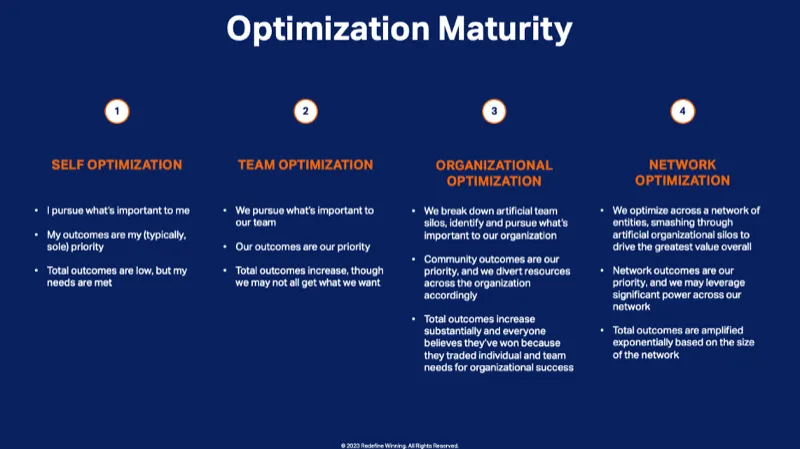
There are three levels at which optimization can happen: the individual, the team, and the network of teams across the organization. Most leaders treat team optimization as the ceiling. It is not. The largest gains appear when whole organizations and ecosystems learn to optimize together.
Reaching that level is harder, and most teams have not yet cleared the team-optimization bar. Recognition, performance management, and reward systems all need to be aligned to reinforce the right behaviors as maturity grows. The practical starting point is honest dialogue about the current state, then a methodology for what good looks like.
What This Means for Leaders
The tragedy of the commons is a warning about what happens when no one owns the collective good. Teams that build the full set of shared resources, capability, decision quality, adaptability, and communication, are the ones that sustain success. Teams that don’t, decline quietly until the numbers force a crisis.
The leader’s job is to make collective success the explicit shared goal, set the expectation that nobody wins until everyone crosses the finish line, and remove the conditions that let self-interest run unchecked. That shift in focus is the antidote, and it is also the difference between a team that limps to its targets and one that compounds.