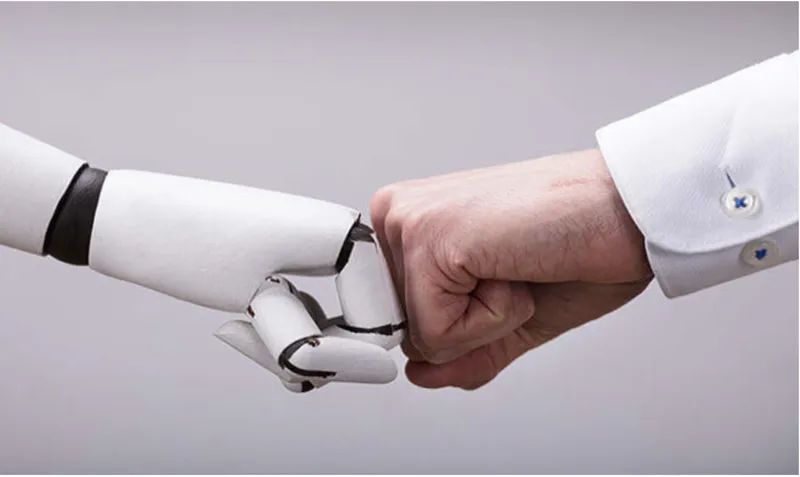
The conversation about AI at work has moved past hype. Employers, leaders, and team members are now considering what it means to work alongside an AI colleague, and depending on where the organization sits on the adoption curve, that colleague may already be onboarded. Even where it is not, AI co-workers will be as common as office laptops within a short window. That has real implications for team members, leaders, and the wider ecosystem of customers and partners.
Why Teaming With AI Is Now A Real Question
Whether or not you welcome it, your competitors are deploying AI inside their organizations. That alone is reason enough to explore what AI can do for your team, your work, and your mission. Done well, AI colleagues bring diverse perspectives, multidisciplinary collaboration, skill synergy, and meaningful cost savings. The leadership task is no longer whether to engage with AI but how to integrate it into the team in a way that actually works.
What An AI Team Member Looks Like Today
The current state is what Microsoft calls “co-pilot” mode. AI is deployed alongside individual team members to help them complete work faster, to a higher quality, and more comprehensively. Think of it as a co-colleague or work concierge that doubles as a sounding board and a producer. One quietly powerful side effect is that it bypasses the candor problem inside teams. People often hesitate to ask questions, bounce ideas, or coach one another, but they will happily do all of that with an AI co-pilot that does not judge.
The next step, the full deployment of independent, autonomous AI resources, is close. It is sensible to plan for that horizon being a year out, not a decade. Legislation around AI design, application, and deployment is also catching up, so the road is bumpy in places before it becomes a superhighway. Ethical concerns, societal impact, bias, and unintended consequences all need to be designed for, with privacy, transparency, and accountability built in from the start.
The Upside Is Genuinely Step-Change
The benefits of AI colleagues are not incremental. Among them:
- Automation of repetitive and increasingly complex tasks
- Data analysis and decision support at scale
- Collaborative filtering and knowledge sharing across the team
- Augmented decision-making and problem-solving
- Personalized workflows and recommendations
- Enhanced communication and coordination
This is closer in scale to the move from manufacturing to IT than it is to a normal tooling upgrade. Organizations that internalize that framing will plan, invest, and reorganize accordingly.
The Challenges Are Real, Too
Job displacement is the first concern most teams raise, and the concern is legitimate. The more useful framing is abundance: how can AI help each person do more fulfilling work, more easily, and grow the business co-exponentially rather than shrinking headcount? There is a real risk that underrepresented groups become early targets for displacement, which makes deliberate equity in deployment a duty.
There is also a “them and us” risk inside the team. Treating an AI colleague as not really part of the team produces the same dynamic as a poor onboarding for a human hire: rejection, wasted potential, and a team that quietly closes ranks. Upskilling is required so people can interact with AI well, and ethical use, bias mitigation, and integration practices all need active design. Many AI providers do not yet know how to integrate with teams; vendors who understand how teams actually function will win.
Teaming Competencies Are The Foundation
For AI to work inside a team, the team needs to know how to team. The strongest predictor of a smooth AI integration is a culture of effective teaming competencies already in place: high candor, real collaboration where the team owns success together, peer-to-peer accountability, and a focus on 10X outcomes rather than 5 to 10 percent improvements. A team with those traits absorbs a new AI colleague the same way it absorbs a strong new human hire.
Communication Becomes The Differentiator
The winners in an AI-enabled team are not necessarily the most technical members. They are the ones with strong interpersonal skills who can facilitate dialogue and frame requests as effective conversations with AI tools. As Andrej Karpathy, former head of AI at Tesla, put it: “The hottest new programming language is English.” That is why prompt engineering roles command $300,000 salaries and more.
What This Means For Leaders
The right starting point is rarely the technology. It is the team. Bring people into the conversation early, co-create the answers, and build the teaming competencies that make any future colleague effective from day one. Done well, this turns AI from a threat narrative into a multiplier for the work people want to do.