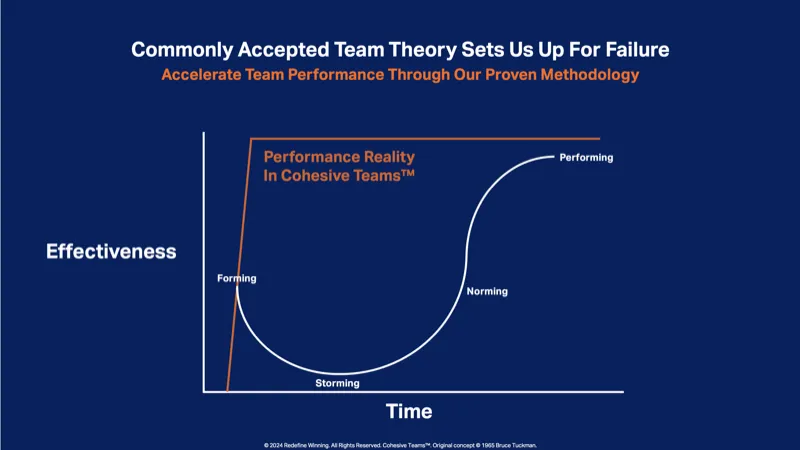
Most leaders have been handed a teaming playbook that is sixty years old. Tuckman’s forming-storming-norming-performing model was a breakthrough in its time, but it was built for a world of stable hierarchies, slow communication, and lifelong jobs. Teams today face conditions none of those assumptions hold for, yet most still apply the old mindsets, practices, and tools to problems they were never designed to solve. The result is predictable: only 5% of teams are achieving their full potential.
Team Longevity Is Not A Proxy For Effectiveness
A team that has worked together for ten years is not automatically a high-performing team. Effectiveness comes from agreed ways of working, not from time on the clock. Every time a member leaves, a new member joins, or someone changes role, the team needs to reset and re-agree how it operates. In practice, this almost never happens, which is why long-tenured teams often look indistinguishable from brand-new ones.
Defining “team” matters here too. The most useful definition is the group of people you need to partner with to be successful, regardless of who reports to whom. Reporting lines are an artifact; partnership is the reality.
The 1% Math That Most Leaders Miss
The cumulative contribution of a team is not a linear average. It compounds. A sustained 1% reduction in daily effort by a demotivated team member translates into roughly a 40X drop in annual performance. A sustained 1% increase in discretionary effort from an empowered team member compounds into roughly 37X improvement.
Most leaders look across the team, see one or two stars, one or two laggards, and an average middle, and conclude things are “fine.” That mental model is the trap. Each person operates as a multiplier, not an addend. One significantly underperforming member drags the whole team’s output down, even when everyone else is doing well. That math is why the Team Architect role matters so much, and why most organizations underserve it.
What A Team Architect Actually Does
The Team Architect role sits with every leader and every team member, not just the named manager. It involves:
- Agreeing ways of working every time the team’s composition changes, including mindsets, behaviors, practices, and tools.
- Mitigating the impact of underperformance rather than averaging it into the group’s results.
- Maximizing the team’s opportunities by pairing complementary strengths and clarifying decision rights.
- Resetting after every change because new members, departures, and role shifts all reset the team’s effective operating contract.
This is closer to system design than to people management. Done well, it lets a team reach the performing stage in hours rather than months.
Why Old Theory Sets Teams Up To Fail
Twelve specific determinants of effective teams now have decades of evidence behind them, and almost none of them are reflected in the teaming theory most leaders were trained on. Forming, storming, and norming describe symptoms, not causes. Treating those phases as inevitable preconditions is what makes the journey to performing slow. With the right diagnostic and interventions, teams skip the prolonged storming phase entirely.
The world has changed substantially in sixty years. Communication is instant, work is distributed, and the volume of change a team has to absorb each year keeps rising. Sticking with sixty-year-old theory in this environment isn’t tradition; it’s a handicap.
What This Means For Leaders
The honest question is not whether your team can achieve its full potential, or how long it might take. It is whether you, as a leader and a Team Architect, are prepared to apply the latest thinking, or whether you’ll keep using outdated ideas and accept the predictable result.
Even the best teams need an occasional adjustment. Variability in effectiveness has very little to do with how long a team has been together and almost everything to do with whether they have agreed mindsets, behaviors, practices, and tools. Leaders who own the Team Architect role get exponential results from the same headcount; leaders who don’t end up working harder for less. Pick deliberately.