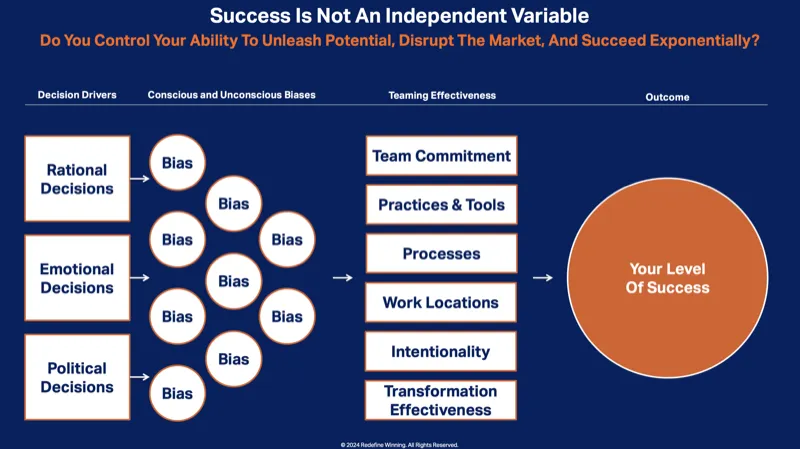
Most leaders treat team success as a straight line: pick a target, push for it, repeat next quarter. The reality is messier. Success is a dependent variable, shaped by what you choose to keep stable, what you choose to transform, the biases each person brings, and how the team agrees to work together. Treat any of those as a fixed input and the math stops working.
Stability and Transformation Are Both in the Job Description
Whether the day starts in an office, a home setup, or a hotel room between flights, the work is the same: deliver outcomes for the week. Behind that simple framing sit two questions that pull in opposite directions. Is the job to hold things steady, or to change them? And how do you do both at once without one undermining the other?
In practice, almost every role is a blend. Some processes, controls, and commitments must not move. Others, including processes, technology, supply chains, and people development, must move quickly. Leaders who treat their role as one or the other tend to overinvest on the side that feels safer and underinvest on the side that pays. The first step toward better odds is naming, deliberately, which parts of the work require stability and which require transformation.
Transactional Teams Get Disrupted
Teams that frame success as turning the handle and shipping the same outputs week after week become targets. The signals are familiar: phrases like “if it isn’t broken, don’t fix it,” prioritization happening at the individual level rather than the team level, and missed deadlines treated as one-off events rather than a pattern. Industries change underneath that posture, and the team is usually the last to notice.
Transformation isn’t a slogan. It is a willingness to challenge what got the team here, change how decisions get made, and accept that some sacred cows have to go. That work is uncomfortable, and the discomfort is the point.
Bias Quietly Decides the Outcome
Even when leaders intend to balance stability and change, bias bends the result. People over-weight what worked for them in the past. They confuse seniority with judgment. They mistake activity for progress. Two leaders looking at the same data routinely choose different priorities because their histories pull them in different directions.
Naming bias out loud is the cheapest intervention available. Teams that pressure-test their own assumptions, invite dissent, and look for what they could be wrong about move faster than teams that don’t. Without that habit, the loudest voice tends to win, and the loudest voice is rarely the most accurate one.
How a Team Decides to Work Together Is the Variable Most Leaders Ignore
Almost every team will discuss what it is trying to achieve and why it matters. Almost no team will discuss how its members will actually work together to get there. Our research shows roughly 99.99% of teams skip that conversation entirely, which is why only about 5% report achieving their full potential.
The cost of that omission compounds. A 1% drop in team effectiveness each day translates to a 100x reduction in annual outcomes, because the misalignments stack on top of each other. Effective teaming behaviors, including candor, shared accountability, decision rights, and rituals for surfacing problems early, are the lever that moves the success variable. They are not the soft layer; they are the operating system.
A Practical Path to Better Odds
Improving the odds doesn’t require a reorganization. It requires a handful of disciplined moves:
- Separate stability work from transformation work. Name what must hold and what must change, and resource them differently.
- Surface bias deliberately. Build in moments where the team explicitly asks what it could be wrong about.
- Co-create how the team will operate. Agree on decision rights, escalation, candor norms, and what “done” means before the work starts.
- Measure cohesion alongside output. Treat alignment, trust, and shared accountability as leading indicators of results.
What This Means for Leaders
Success doesn’t arrive because someone picked the right target. It arrives because the team built the conditions in which that target was reachable. The leaders compounding 10x outcomes are not working harder than their peers; they are treating teaming as the dependent variable they actually control and investing in it accordingly.
The honest test is whether your team has ever sat down and agreed how it works together. If the answer is no, that is the variable to change first. Everything else, including strategy, technology, and effort, leans on it.